Idioms and Phrasal Expressions: How to Translate the Untranslatable
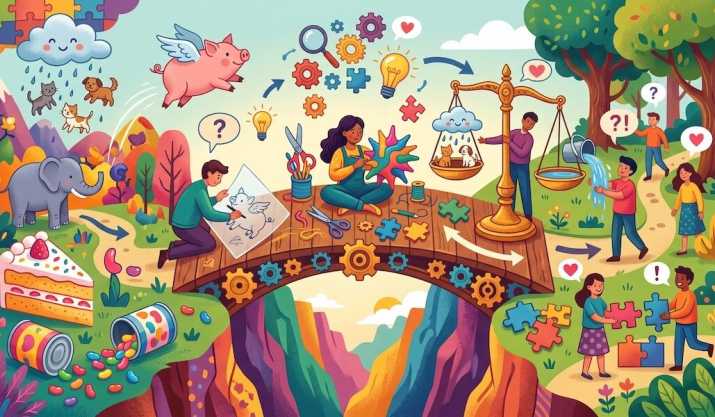
Try explaining to a foreigner why the phrase "neither fluff nor feather" (ni pukha ni pera) is a wish for good luck, and why the response to it requires a mandatory curse. Set expressions represent a true nightmare for an inexperienced philologist and, at the same time, a favorite puzzle for a true master of the craft. Literal interpretation of idioms is capable of turning a serious business speech or literary text into an absolutely absurd collection of words. It is precisely the transfer of figurative meanings between different language systems that clearly demonstrates why even the most advanced machine algorithms are still inferior to humans. In this article, we will examine in detail the tasks a specialist faces when working with figurative speech and review proven strategic techniques that help preserve the spirit and meaning of the original.
Why Literal Translation Is a Dangerous Trap
The phraseology of any nation reflects its centuries-old history, daily life, climate conditions, and national character. When an experienced translator takes on a text rich in vivid metaphors, their main goal is not to convey individual words, but to recreate the exact emotional and semantic effect. An attempt to translate the English expression "piece of cake" literally as a slice of cake in the context of describing a complex work task will only cause bewilderment for the reader. In Russian, a natural phrase here would be simpler than a boiled turnip or a pair of trifles.
A similar situation arises with the well-known wish of good luck to performers before going on stage, "break a leg." The literal transfer break a leg sounds ominous and extremely strange in Russian, although in terms of meaning it is the exact equivalent of our traditional wish "neither fluff nor feather." If a specialist fails to recognize a set expression and reproduces it word for word, the semantic structure of the statement will be completely destroyed. In business correspondence or negotiations, such carelessness can trigger a serious conflict or ruin a deal. It is precisely such mistakes that form the main translation challenges, turning beautiful and lively speech into comical or ridiculous confusion.
Finding a Full and Direct Equivalent
The first and most preferred strategy when working with set expressions is finding a full equivalent. This is a situation where an idiom exists in the target language that completely matches the source both in meaning and in its internal figurative form. Such overlaps are often explained by common historical roots among European nations, ancient heritage, or direct borrowings from the Bible.
For example, the famous phrase "to play with fire" sounds almost identical and is perceived identically in most European languages. In such favorable cases, professional translation does not present serious difficulties: the specialist simply uses an existing structural match while preserving the stylistic tone of the original. However, absolute equivalents are far from common. Daily life, geographical location, and cultural traditions of different nations have formed unique metaphorical systems requiring other methods of adaptation.
Using a Functional Analogue
When there is no direct match, the search for a functional analogue comes into play. This strategy consists of selecting a set expression in the target language with a similar meaning, but built on a completely different visual or everyday image. Numerous examples of such a cultural shift can be cited.
Take the famous English idiom "it is raining cats and dogs." Literally, this means that cats and dogs are falling from the sky, but in terms of semantic load, it corresponds to our familiar torrential rain, when it pours like from a bucket. The German expression "Tomaten auf den Augen haben" literally translates as having tomatoes on one's eyes. For a Russian speaker, this image is unfamiliar, although the emotional message fully corresponds to the phrases not seeing beyond one's own nose or as if one's eyes were blinded.
No less curious is the French phrase "avoir le cafard," which literally translates as having a cockroach. In reality, French speakers use it to describe a state of melancholy, gloom, and deep blues. And if a Spaniard says "estar como una cabra," that is, to be like a goat, they do not mean horns or stubbornness at all, but rather the behavior of a person who has gone mad or is acting completely inappropriately. High-quality idiom translation requires a philologist's ability to instantly find these emotional parallels without losing the natural sound of their native language.
Calquing and Preserving Metaphorical Freshness
There are situations when the author of the original uses a completely new, authorial, or rare national metaphor for which there is no ready-made analogue in the target language. In such cases, a qualified linguist can apply calquing, that is, a word-for-word translation of the expression, provided that the resulting image is understandable to the reader and enriches the text.
Calquing works great in fiction and journalism, when it is important to preserve the national flavor of the original. If the image is transparent and easily readable from the general context, word-for-word transfer allows for conveying the author's unique vision. However, this method should be applied with great caution: if the metaphor seems alien, unfamiliar, or creates false associations, calquing will only harm the perception of the text.
Descriptive Translation as a Last Resort
What should be done if there is neither a direct equivalent nor a suitable analogue in the receiving language, and literal calquing turns the sentence into nonsense? In such a situation, translation challenges are overcome through a competent interpretation of the semantic core. The specialist deliberately abandons imagery and reveals the meaning of the idiom using neutral lexical means.
For example, the English expression "bite the bullet" literally means to bite a bullet, but in meaning it means to grit one's teeth and do something unpleasant. If the image is not recognizable in a specific context, it is translated descriptively: to courageously accept the inevitable. Descriptive translation of idioms is often used in official documentation, technical materials, and business correspondence, where information accuracy is more important than stylistic delights. Although this method inevitably deprives the text of its former vivid emotional coloring, it makes it possible to completely avoid distortion of meaning and guarantees correct understanding of the message by the audience.
The Role of Context and Deep Localization
Competent professional translation of set expressions is impossible to imagine without considering the broad context. The same expression in different situations may require completely different translation solutions. The choice of a suitable strategy is influenced by the genre of the text, the target audience, the general mood of the work, and even the publication format.
When comprehensive localization of advertising campaigns or mobile applications is carried out, working with idioms becomes a key factor for success. An advertising slogan containing national humor or a vivid metaphor cannot simply be translated. It must be rethought and recreated anew for a new cultural environment. High-quality localization allows for giving the brand a natural sound, turning the specialist into a reliable cultural bridge between the author and the audience.
Practical Advice for Clients and Translators
To work successfully with phraseology, several important rules must be observed. Novice specialists should constantly expand their folkloric and cultural horizons, regularly read literature in the original language, and use specialized phraseological dictionaries. Do not be afraid to depart from the literal structure of the original if the naturalness and harmony of native speech require it.
Clients of language services must understand that high-quality adaptation of figurative speech requires time and high qualifications. If your text contains a lot of humor, wordplay, or national metaphors, entrusting it is worth exclusively to professionals. A competent translator will successfully overcome any translation challenges, while professional translation and accurate text localization will make your content understandable and close to readers from any country. This is the main skill when translating idioms.