Interpreting at Events: How Clients and Speakers Should Prepare
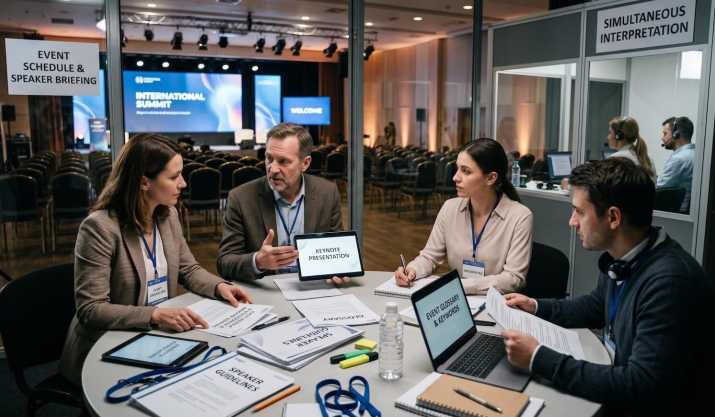
Organizing an international event—whether a major economic summit, an intimate scientific symposium, closed investor negotiations, or an executive training seminar—inevitably requires overcoming language barriers. The success of cross-border dialogue hinges entirely upon the professional caliber of the interpreter. Yet even an elite conference interpreter becomes vulnerable if event logistics fail to observe fundamental linguistic prerequisites. The vast majority of communication breakdowns during public presentations stem not from inadequate interpreter qualifications, but from organizational deficiencies: absent reference documentation, defective audio hardware, or speakers who disregard the core realities of live bilingual rendering.
In professional language services, a foundational truth applies: premier spoken interpretation is largely forged long before the presenter mounts the rostrum. The client organization and the speaker act as co-creators of this outcome, directly shaping how faithfully every concept is delivered. Mastering the key planning stages, hall acoustic requirements, and collaboration dynamics prevents embarrassing disruptions, safeguards the timetable, and guarantees seamless mutual comprehension across a multinational audience.
Simultaneous or Consecutive Interpreting: Choosing the Right Format
The first critical decision in designing an event agenda is selecting the optimal interpretation format. Consecutive interpreting requires the speaker to pause every two or three sentences, allowing the linguist to convey the message in the target language. This mode is traditional for gala dinners, press briefings, industrial field visits, and bilateral discussions with compact delegations. Its primary advantage is minimal hardware overhead, as standard sound reinforcement is generally sufficient. However, the operational compromise is temporal: proceedings naturally expand by fifty to one hundred percent, demanding rigorous schedule adjustments.
Simultaneous interpreting occurs concurrently with speech delivery with a lag of only a few seconds, allowing listeners to absorb content in real time through dedicated headsets. This mode is indispensable for large-scale congresses, high-level summits, and multilateral webcasts with demanding itineraries and multiple working tongues. Simultaneous interpreters invariably operate in pairs within soundproof booths, alternating every fifteen to twenty minutes due to intense cognitive strain. This preserves natural pacing but requires seasoned specialists and specialized acoustic equipment.
Technical Venue Equipment and Sound Requirements
Acoustic comfort for the interpreter is not a luxury; it is an absolute technical prerequisite for linguistic accuracy. A linguist cannot translate what cannot be distinctly heard. Substandard lapel microphones, ventilation hum, room reverberation, or wireless interference can completely disable a booth team. When an orator paces away from the lectern without a microphone, the audio feed in attendee headsets abruptly cuts out, creating an impression of operational amateurism across the entire service.
For simultaneous interpretation, renting certified equipment is imperative: stationary or modular soundproof booths meeting ISO standards, dedicated interpreter consoles, radio transmitters, and digital delegate receivers. The booth must provide an unobstructed direct sightline to the dais and presentation screens. Where physical line of sight is impossible, organizers must supply low-latency video feeds of the speaker and slides directly to booth monitors. A resident audio engineer must remain on site throughout the proceedings to adjust frequency response and gain levels dynamically.
Preparing Materials and Glossaries for Interpreters
A pervasive misconception among organizers is that experienced linguists possess encyclopedic mastery across every scientific and industrial discipline. In truth, even the most accomplished conference interpreter is an expert in communicative transfer rather than a practicing biochemist or turbine design engineer. Deep subject-matter fluency is attained through rigorous pre-event briefing, requiring several days to a week of preparation. The earlier interpreters receive orientation assets, the more natural and authoritative their technical vocabulary will sound.
The briefing package should reach the language team at least five to seven business days before the event. A complete dossier contains the following vital components:
• Written speeches, draft remarks, and delegate handouts that enable interpreters to map out core arguments and rhetorical transitions in advance.
• Final presentation decks, including hidden technical slides, flowcharts, statistical exhibits, and financial graphics.
• Corporate glossaries, internal terminology registers, and exhaustive lists of proprietary acronyms with authorized expansions.
• Rosters of key delegates, moderators, and speakers with full names, academic degrees, corporate titles, and institutional affiliations.
Speaker Briefing: Pacing, Pauses, and Speech Delivery
Interpretation quality is directly intertwined with the speaker's delivery discipline. An effective orator remains constantly mindful of the bilingual bridge and modulates presentation pace accordingly. Maintaining an even tempo of one hundred to one hundred twenty words per minute is essential. Rushing through a dense fifteen-page paper in an allotted ten-minute slot forces interpreters into drastic semantic compression, shedding vital nuances to preserve basic continuity.
Presenters should refrain from reciting extensive sequences of complex figures without visual slide support, and avoid culture-specific idioms, regional wordplay, or local humor. Puns rarely translate simultaneously without losing their comedic intent. Speakers should introduce brief pauses before core conclusions, address microphones directly, and never tap fingers or pens against the podium, which transmits concussive acoustic pops directly into the interpreters' earpieces.
Practical Case Studies and Rules for Flawless Execution
Field experience highlights how thorough advance coordination regularly preserves high-stakes international proceedings. At a premier energy summit, a keynote speaker substituted his general slide deck with a deeply technical offshore drilling paper two hours before taking the stage. Because organizers had scheduled a mandatory fifteen-minute speaker briefing with the interpreters, the team rapidly harmonized novel technical terms, resulting in an immaculate ninety-minute presentation. Conversely, at a medical symposium where an organizer withheld papers citing trade secrets, sessions were repeatedly disrupted as interpreters had to halt proceedings to verify obscure pharmacological nomenclature live.
The practical conclusion is indisputable: live event interpreting is a collaborative discipline requiring diligent advance planning. The client must select the appropriate delivery format, secure professional venue audio hardware, and provide comprehensive briefing collateral well in advance. Speakers must maintain measured cadence and respect the realities of multilingual reception. Only unified teamwork between event organizers, presenters, and the language service team guarantees an impactful event that elevates institutional prestige on the global stage.