Why Chinese, Japanese, and Korean Are Three Distinct Universes for the Translator
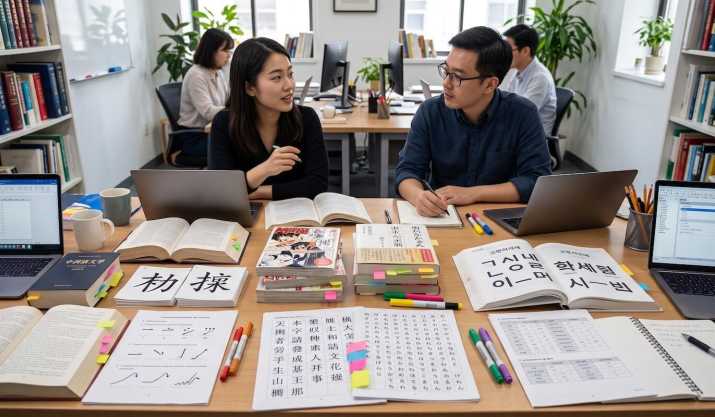
There is a widespread misconception that East Asian languages form a unified group of Oriental writing systems, where learning a few hundred shared characters is supposedly enough to understand speech in Beijing, Tokyo, and Seoul fluently. To someone unfamiliar with linguistics, Chinese, Japanese, and Korean often appear to be nearly interchangeable dialects of a single enigmatic region. For a professional linguist, however, they represent three entirely distinct, fundamentally dissimilar universes, each with its own grammatical logic, cultural codes, and unique historical trajectory. Attempting to approach them with a one-size-fits-all template inevitably leads international business into a dead end, resulting in gross communication failures and financial losses. In this article, we examine in detail the fundamental differences among the major East Asian languages, the translation challenges that await specialists, and why competent content localization demands a profound grasp of the local mindset.
Origins and Language Families: Isolating Structure Versus Agglutination
From the perspective of comparative-historical linguistics, these three languages are not even related. Chinese belongs to the Sino-Tibetan language family and has an isolating structure. It has virtually no inflectional endings, prefixes, or suffixes, and grammatical relationships are expressed through strict word order and grammatical particles. Furthermore, Chinese is a tonal language: the exact same syllable, pronounced with different tones, shifts in meaning from mother to horse or to scold. The basic word order in a Chinese sentence resembles that of European languages: subject, verb, object (SVO).
Japanese and Korean are organized fundamentally differently. Most contemporary scholars classify them as language isolates or link them to the hypothetical Altaic macrofamily. Both languages are agglutinative: chains of suffixes are sequentially attached to an immutable word root, with each suffix conveying a specific grammatical meaning, case, or degree of politeness. Their word order is the exact opposite of Chinese: the predicate is always positioned at the very end of the sentence (SOV). When an experienced translator works with spoken Japanese or Korean, they must listen to the speaker's sentence to the very last syllable, as it is the final verbal suffix that determines whether the speaker is affirming a thought, negating it, or asking a rhetorical question.
Writing Systems: Logographs, Syllabaries, and a Scientific Alphabet
Writing represents another sharp dividing line among the three cultures. China uses an exclusively logographic system—hanzi characters, where each symbol encodes not a sound, but an entire concept or morpheme. In this context, the specialist encounters a division between simplified characters, adopted in mainland China and Singapore, and traditional characters, utilized in Taiwan and Hong Kong.
Centuries ago, Japan borrowed Chinese characters, but adapted them to its complex grammar, creating the world's most intricate writing cocktail. A modern Japanese text simultaneously combines four systems: kanji characters for word roots, the hiragana syllabary for grammatical inflections, a second syllabary, katakana, for foreign loanwords, and the Latin alphabet, romaji, for acronyms and brand names.
Korea took an entirely unique path. Until the mid-fifteenth century, Koreans used Chinese hanja characters, but these were ill-suited to convey the phonetics of spoken Korean. In 1446, King Sejong the Great introduced Hangul to the world—one of the most refined and logical phonetic systems in human history. The letters of Hangul visually mimic the shape of the speech organs when producing sounds and are arranged into neat, square syllabic blocks. Today, Korean texts are written almost exclusively in Hangul, while hanja characters are preserved only in legal documents, historical scholarship, and to resolve semantic homonymy.
Grammar, Contextuality, and the Mystery of Missing Pronouns
Structural translation challenges are intensified by the high contextuality of Japanese and Korean cultures. In both languages, a crucial role is played by special topic and case-marking particles, such as the Japanese wa and ga or the Korean eun and neun. They clearly delineate the topic of an utterance (what is already known) from the rheme (the new semantic information).
At the same time, in everyday speech and business correspondence, Japanese and Koreans strive to avoid personal pronouns like I, you, or he whenever possible. The direct use of a second-person pronoun is often perceived by the interlocutor as rude or an intrusion into personal boundaries. Consequently, both the subject and the object are routinely omitted from sentences, leaving the entire semantic weight to the situational context. Automated algorithms and machine translation tools completely lose the narrative thread in such scenarios, attributing actions to random entities. Only qualified human professional translation can reconstruct the true logical connections and the author's original intent.
Hierarchy, Politeness, and Social Distance
In East Asian societies, language serves as the primary tool for maintaining social harmony and strict subordination. Japanese features an elaborate politeness system known as keigo, which is divided into three basic registers: the neutral-polite teineigo, the respectful sonkeigo used to elevate the interlocutor, and the humble kenjougo used to lower the speaker. An incorrect choice of verb form when communicating with a Japanese partner instantly shatters the atmosphere of trust.
Korean linguistic tradition encompasses seven distinct speech levels of politeness, determined by age, professional rank, and the degree of kinship among the conversation participants. Even an age difference of a single year demands an immediate shift in speech register and the use of specific honorific suffixes. A direct, word-for-word translation of European contracts or presentations without adaptation to East Asian etiquette norms appears ignorant and provocative in the eyes of Asian partners. This is precisely why East Asian languages require a linguist to possess not only philological expertise, but also an impeccable grasp of sociocultural etiquette.
Nuances of Localization for Regional Markets
When a company undertakes comprehensive localization of digital products, websites, or software for the region's markets, the technical team encounters specific challenges. Character-based text occupies substantially less horizontal space than Cyrillic or Latin script, yet requires greater line spacing due to the high density of graphic strokes. Poorly chosen fonts cause intricate characters to blur into unreadable smudges.
Furthermore, successful localization is impossible without integration into closed local digital ecosystems. In China, Western services are supplanted by the search engine Baidu and the super-app WeChat; in Japan, Yahoo Japan and the messaging app Line play pivotal roles; and in South Korea, the portal Naver and the service KakaoTalk are undisputed leaders. It is equally essential to consider cultural taboos and superstitions, such as the region's widespread tetraphobia—an aversion to the number four, the pronunciation of which is homophonous with the word death in all three languages.
Practical Recommendations for Business and Translators
To succeed in the markets of China, Japan, and Korea, it is critical to abandon the illusion of their mutual similarity. Clients of language services should establish separate project teams for each language track and engage native speakers of the specific national varieties.
From their earliest days of training, aspiring specialists should focus not merely on memorizing vocabulary, but also on thoroughly studying historical context, politeness systems, and cultural codes. Any high-quality professional translation into East Asian languages represents a delicate balance between linguistic precision and respect for centuries-old traditions. Only such a conscious approach makes it possible to overcome all translation challenges and build truly strong partnerships with counterparts across East Asia.